Most people aren’t failing on LinkedIn because they’re lazy. They’re failing because they’re treating it like a slot machine. Post something. Pull the lever. Hope for the jackpot.
When nothing converts, they assume LinkedIn doesn’t work for them. But the problem isn’t the platform. It’s that they’re running random content with no system behind it. This is what that looks like from your buyer’s perspective.
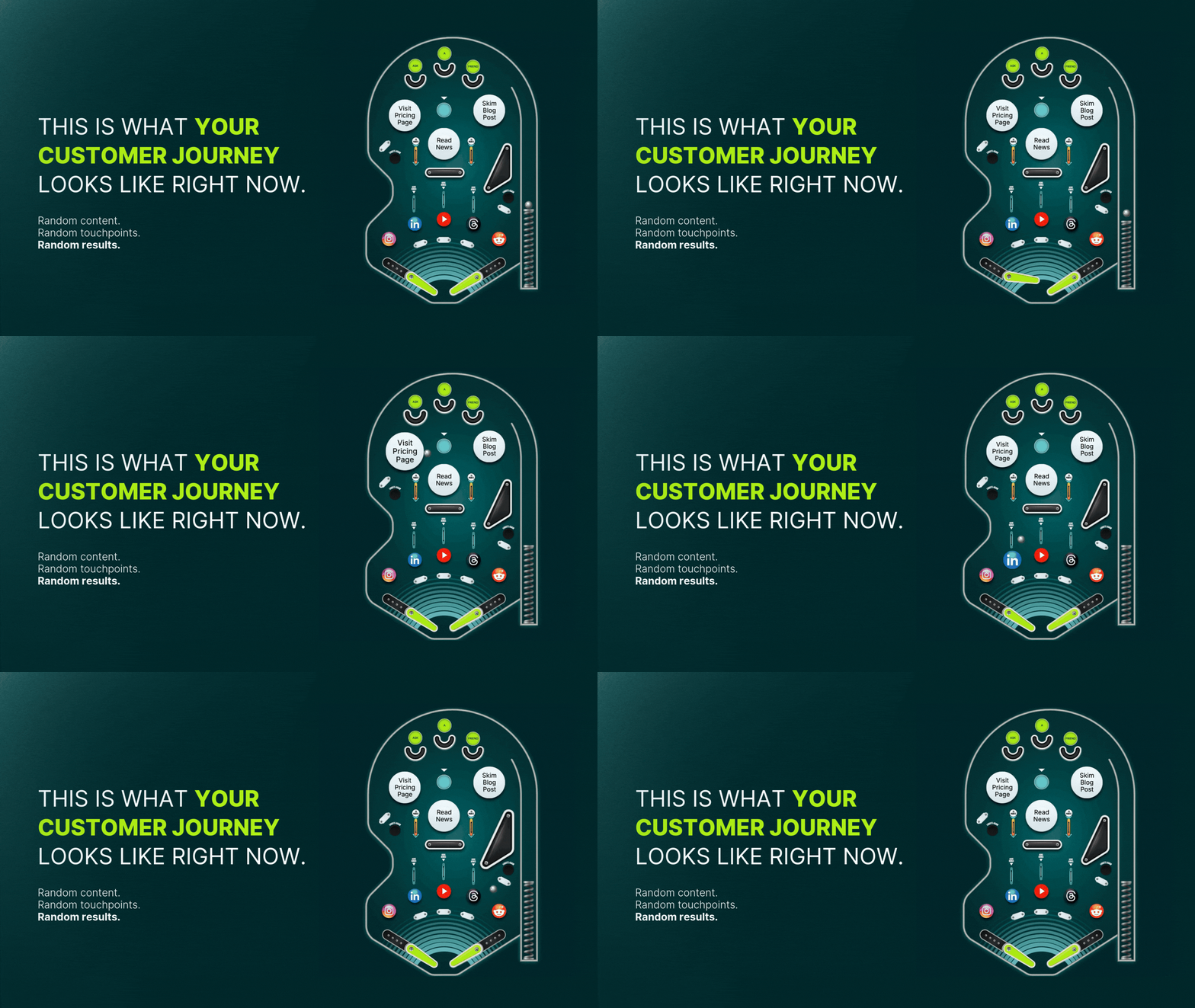
Random content produces random touchpoints. Random touchpoints produce random results. And random results don’t build a business.
At Distinctiva, we’ve helped founders at Semrush, Backlinko, and HeyReach build content engines that compound over time. One client went from $800K to $3.6M ARR with 90% of their pipeline coming from LinkedIn and zero outbound messages sent. That doesn’t happen by accident. It happens because every post in their feed had a job to do, and those jobs worked together as a system.
This is that system.
Why LinkedIn is still the highest-leverage platform for B2B
Before getting into the framework, it’s worth being clear about why LinkedIn specifically. A lot of founders hedge their bets across every platform and end up building nothing meaningful anywhere.
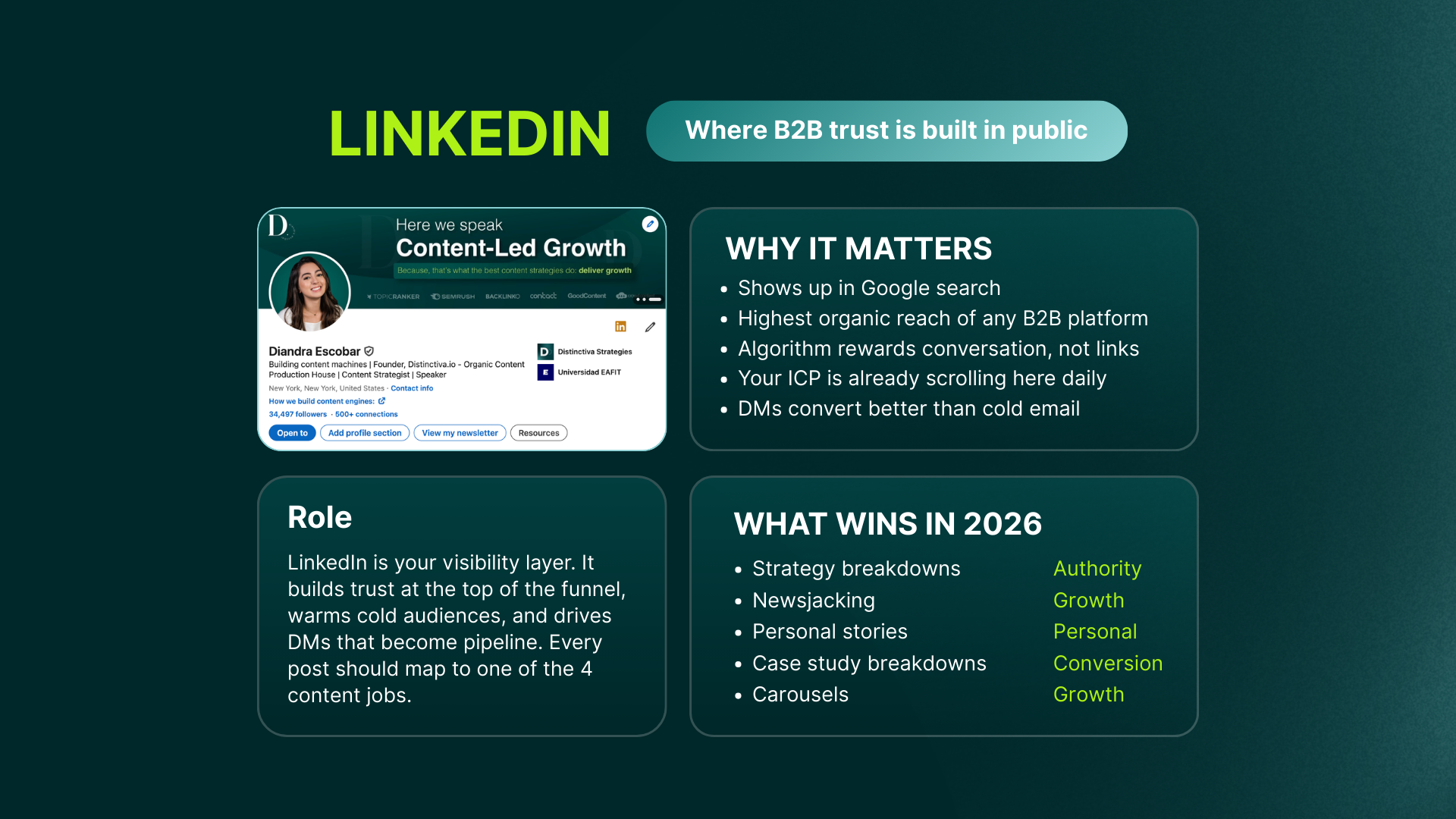
LinkedIn has the highest organic reach of any B2B platform. Your content shows up in Google search results. The algorithm rewards conversation, not link-out posts. Your ICP is already scrolling here every day. And DMs on LinkedIn convert better than cold email because the relationship is warm before the conversation even starts.
LinkedIn is your visibility layer. It builds trust at the top of the funnel, warms cold audiences, and drives DMs that turn into pipeline. Every post you publish here is doing sales work while you sleep.
The other thing worth understanding: discovery is fragmented now. Google, YouTube, Reddit, LinkedIn, ChatGPT, Perplexity – people are finding content across ten or more surfaces. LinkedIn sits at the center of that for B2B. It’s the #2 most cited domain across AI search platforms, which means posts you write today get indexed by tools your buyers are actively using to make decisions. That’s not a reason to abandon other channels. It’s a reason to treat LinkedIn as the anchor.
Content market fit comes before content
Most companies skip this step entirely. They open a content calendar, start filling in post ideas, and wonder six months later why nothing is converting.
Content market fit is the intersection of three forces: your expertise and point of view, what your audience actually needs, and what the algorithm rewards. When those three align, content compounds. When they don’t, you’re creating noise with good intentions.
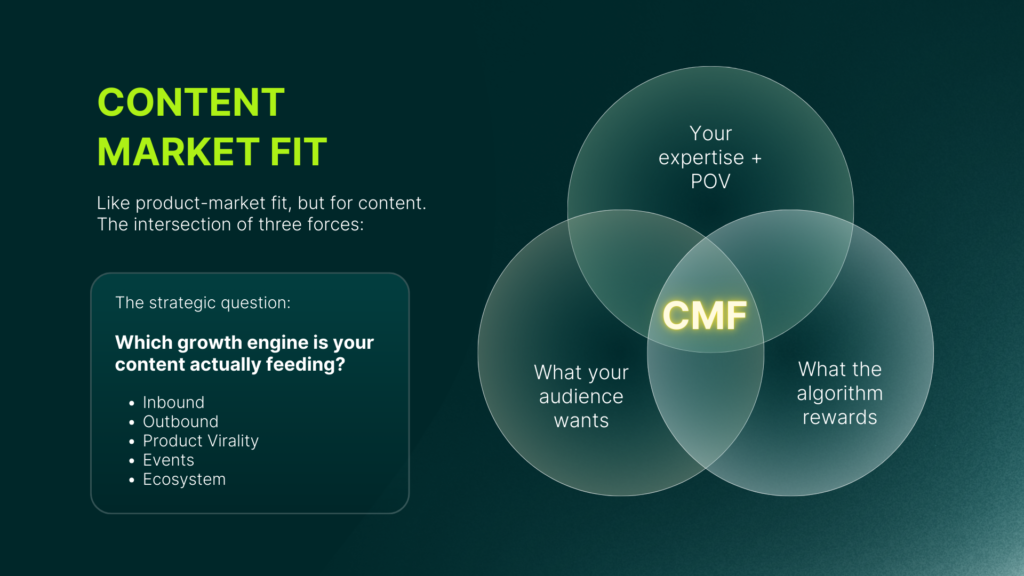
There’s a deeper question underneath this that most people never ask: which growth engine is your content actually feeding? Inbound, outbound, events, product virality, ecosystem – these are all different engines, and the content that fuels each one looks completely different. A PLG company and an inbound-led agency need entirely different content strategies even if they’re posting on the same platform to similar audiences.
Before you write a single post, get clear on what business outcome that content is meant to produce. That clarity is what separates a content strategy from a content calendar.
Every post needs a job – the 4 content buckets
Once you know what engine you’re feeding, you need a mix of content types that work together. At Distinctiva, we use four buckets. These aren’t just categories for staying organized. They’re the four gears that make the flywheel turn.
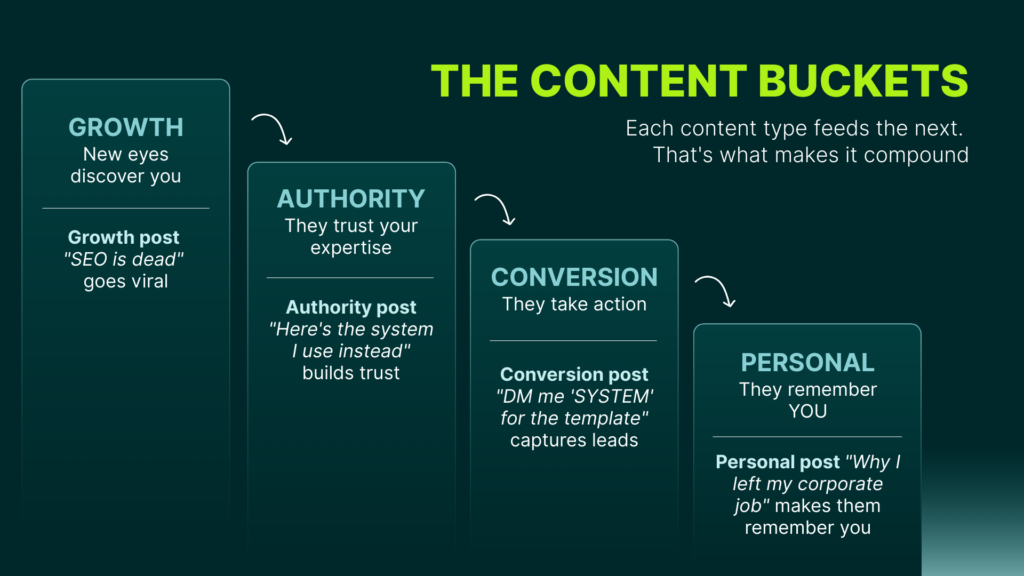
Growth (40%) brings new eyes to your profile. Hot takes, pattern observations, industry commentary, contrarian angles. This is the content that gets discovered by people who’ve never heard of you. It spreads because it says something people either strongly agree with or strongly disagree with.
Authority (30%) builds trust with the people who found you through growth content. Frameworks, systems, case studies, client results. This is where your expertise shows up on the page. Someone who follows you because of a growth post needs to see authority content to believe you can actually help them.
Conversion (20%) turns that trust into action. Lead magnets, direct offers, CTAs, templates. This is the content that drives DMs. It works because growth and authority have done the warmup. Posting conversion content without the other two is why most CTAs feel like ads.
Personal (10%) makes you memorable and referable. Stories, behind-the-scenes, vulnerability. This is the content that makes people feel like they know you – not just what you do. Clients refer people to founders they like, not just founders they respect.
Each type feeds the next. That’s what makes it compound. If you zoom out over any given month at Distinctiva, every client feed hits all four. Some weeks lean heavier on one bucket depending on what’s happening in their business. But the mix stays balanced because each bucket is doing a job the others can’t.
Are you getting reach from the wrong people?
This is the most common problem we see with founders who’ve been posting for a while. They have impressions. They might even have engagement. But nothing converts to pipeline.
The answer is usually that they’re feeding the wrong engine. Content that attracts other marketers when your ICP is a CFO. Thought leadership that builds followers but drives zero product signups for a PLG company. Viral posts that get likes and shares from people who will never buy.
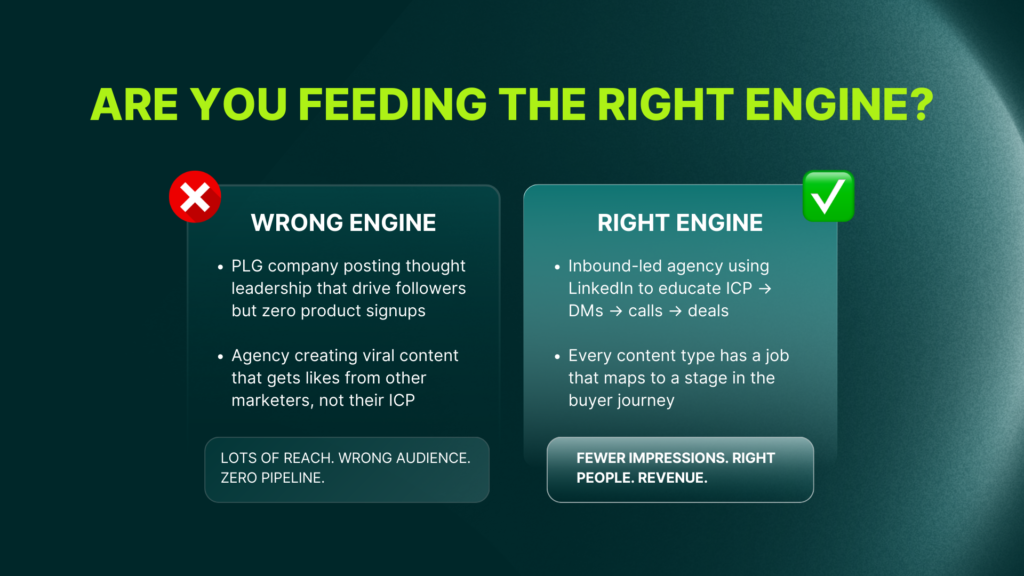
Fewer impressions from the right people will always outperform massive reach from the wrong ones. The goal at Distinctiva has never been to make our clients go viral. It’s to make sure the right person sees the right content at the right stage of their buying journey, and then knows exactly what to do next.
Why design and engagement are part of the system, not extras
Two things get treated as optional that shouldn’t be.
The first is content design. Carousels, one-pagers, and visual posts aren’t decoration. They’re what stops the scroll. When someone saves a well-designed carousel, that save signals to the LinkedIn algorithm that your content has standalone value – the kind people want to come back to. Saves and sends carry more weight than likes and comments in terms of distribution. A post that gets 200 saves and 20 comments will often outperform a post that gets 500 likes and 10 saves.
At Distinctiva, design is built into every client’s content system from day one. Strategy, writing, and design work together because a strong idea in a weak visual format underperforms. The same insight in a well-designed carousel that someone wants to screenshot and share is doing ten times the distribution work.
The second is engagement. Showing up in the comments of posts by people in your space isn’t networking for the sake of it. It’s distribution. Your ICP follows certain creators, hangs out in certain conversations, scrolls certain feeds. When you show up consistently in those places with something worth reading, you’re borrowing reach from audiences that already trust the person you’re engaging with. That’s how you grow before you have a following to grow from.
The content flywheel – from calendar to compounding system
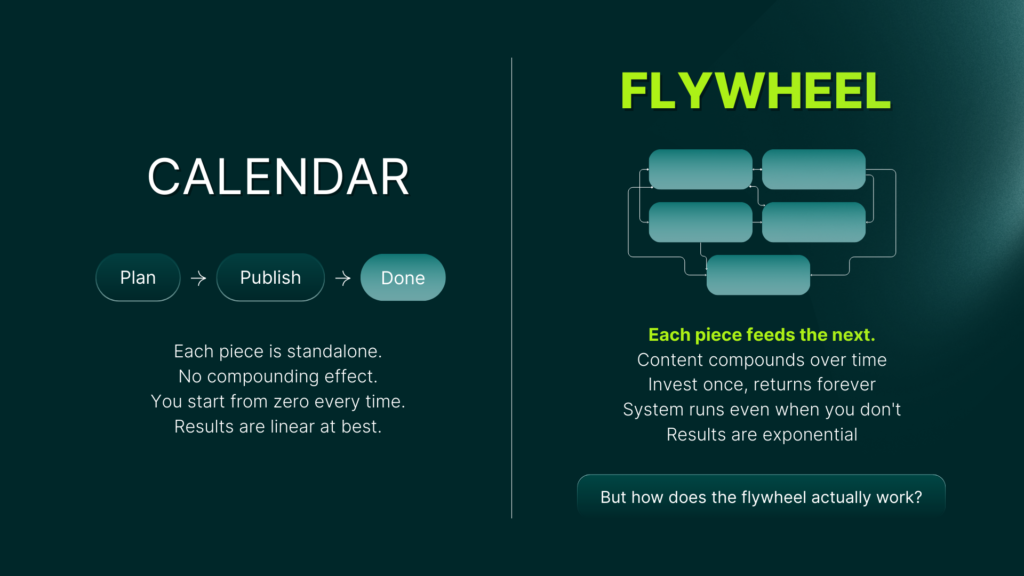
A content calendar is linear. You publish, promote, and start from zero again next week. Every piece of content lives and dies on its own.
A content flywheel is self-reinforcing. One core insight – born from research, audience pain, or a client result – becomes multiple pieces of content, each built natively for a different channel, each with a different job, each feeding the next cycle.
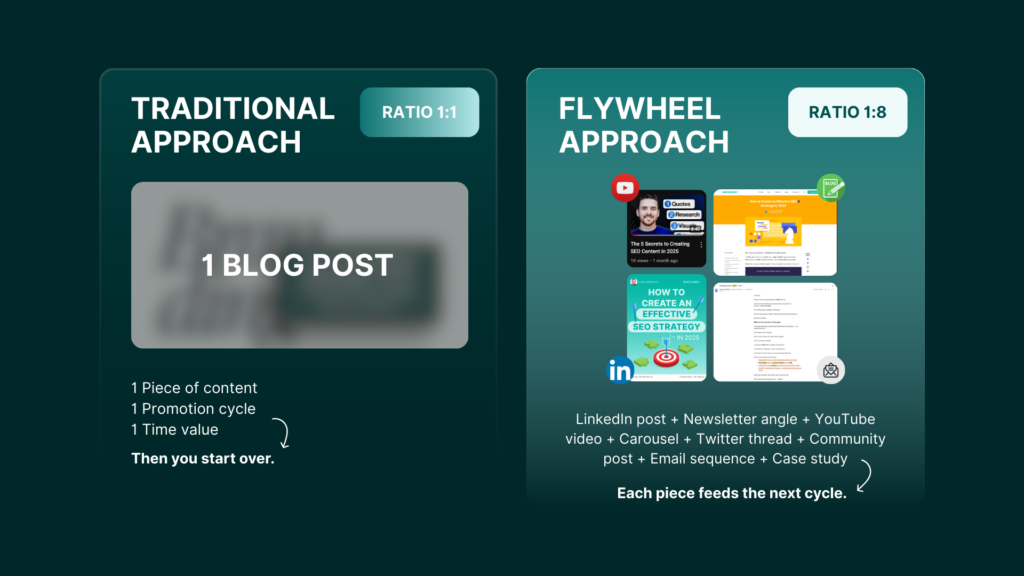
The math is stark. The traditional approach produces a 1:1 ratio. One blog post, one promotion cycle, one time value. Then you start over. The flywheel approach produces a 1:8 ratio. One core insight becomes a LinkedIn post, a newsletter angle, a YouTube video, a carousel, a Twitter thread, a community post, an email sequence, and a case study. Each piece feeds the next cycle instead of dying in isolation.
The four steps of the flywheel are straightforward. Start with one core insight. Turn it into multiple formats, each native to its channel – not copy-pasted across platforms. Give each piece a job (growth, authority, conversion, or personal). Then let the signals from DMs, comments, and data inform what you create next. The flywheel gets smarter every cycle because the feedback from your audience tells you what to double down on.
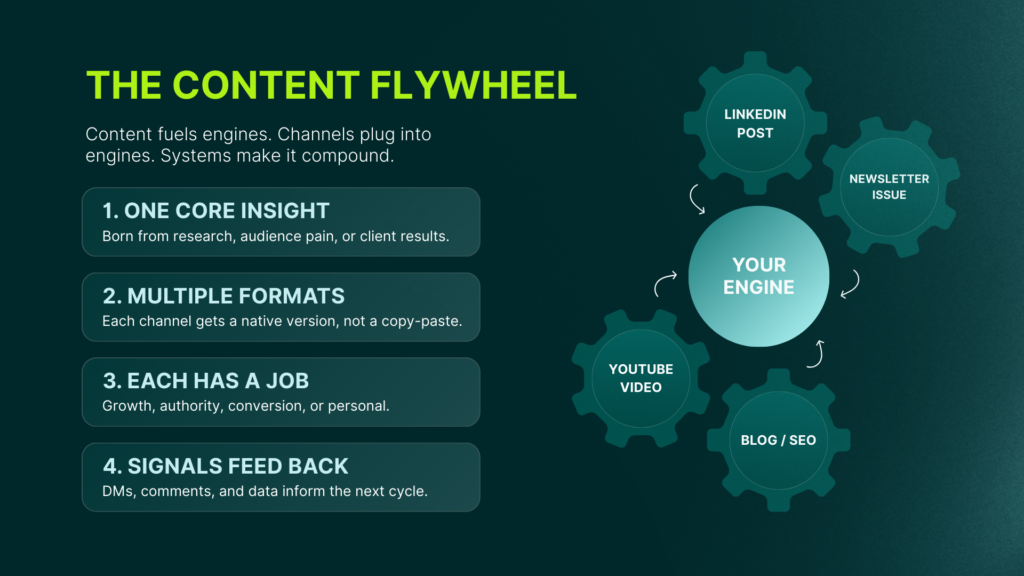
The presentation that became this blog post is a live example. That one piece of content became a YouTube video, a LinkedIn carousel, a newsletter issue, and this article. Same insight. Different formats. Different jobs. All feeding the same engine.
What this looks like when it works
One of our clients came to us as an SEO agency doing $800K ARR. They had a founder with real expertise and zero consistent LinkedIn presence. No system, no content mix, no flywheel.
We built the system from the ground up. Growth posts brought new audience into their world. Authority posts – case studies, frameworks, breakdowns – built credibility with the people who followed. Conversion posts drove DMs. Personal posts made the founder someone people remembered and referred to others.
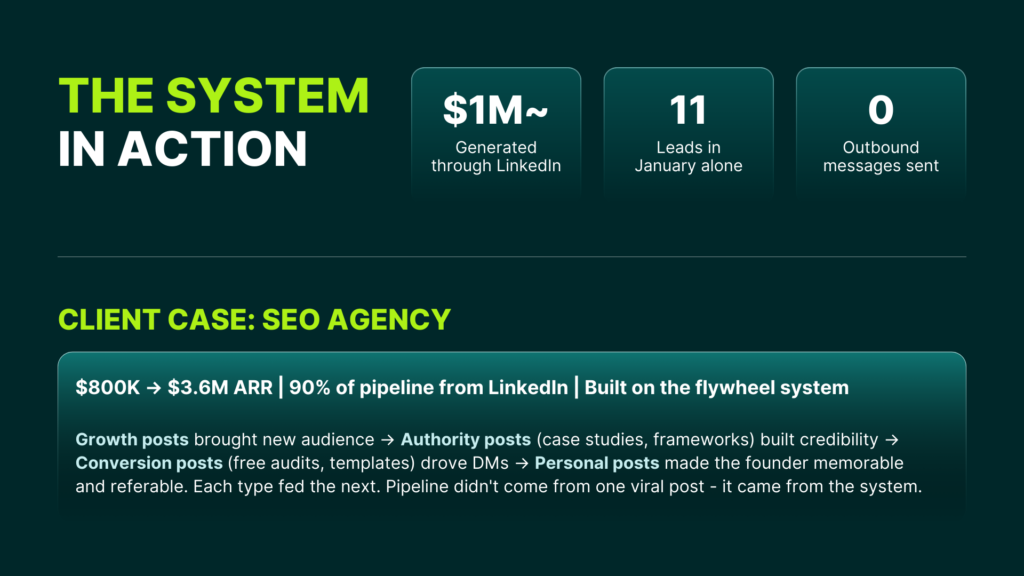
Each type fed the next. Pipeline didn’t come from one viral post. It came from the system running together month after month. They finished at $3.6M ARR. 90% of their pipeline came from LinkedIn. Zero outbound messages sent.
That’s what a content engine looks like when every part is doing its job.
What’s coming next
Everything covered in this post – the content market fit framework, the four buckets, the flywheel, the design and engagement layer – is what we’re packaging into a course. If you want to build this system yourself and want to be the first to know when it drops, pre-register here!
If you’d rather have Distinctiva build it for you, book a call here. No pitch, no pressure – just an honest conversation about whether this is the right move for your business right now.